GreenieRE FAQs: Your Questions About Reinsurance, Climate Risks, and More Answered
Highlights from an Insurance Ask Me Anything
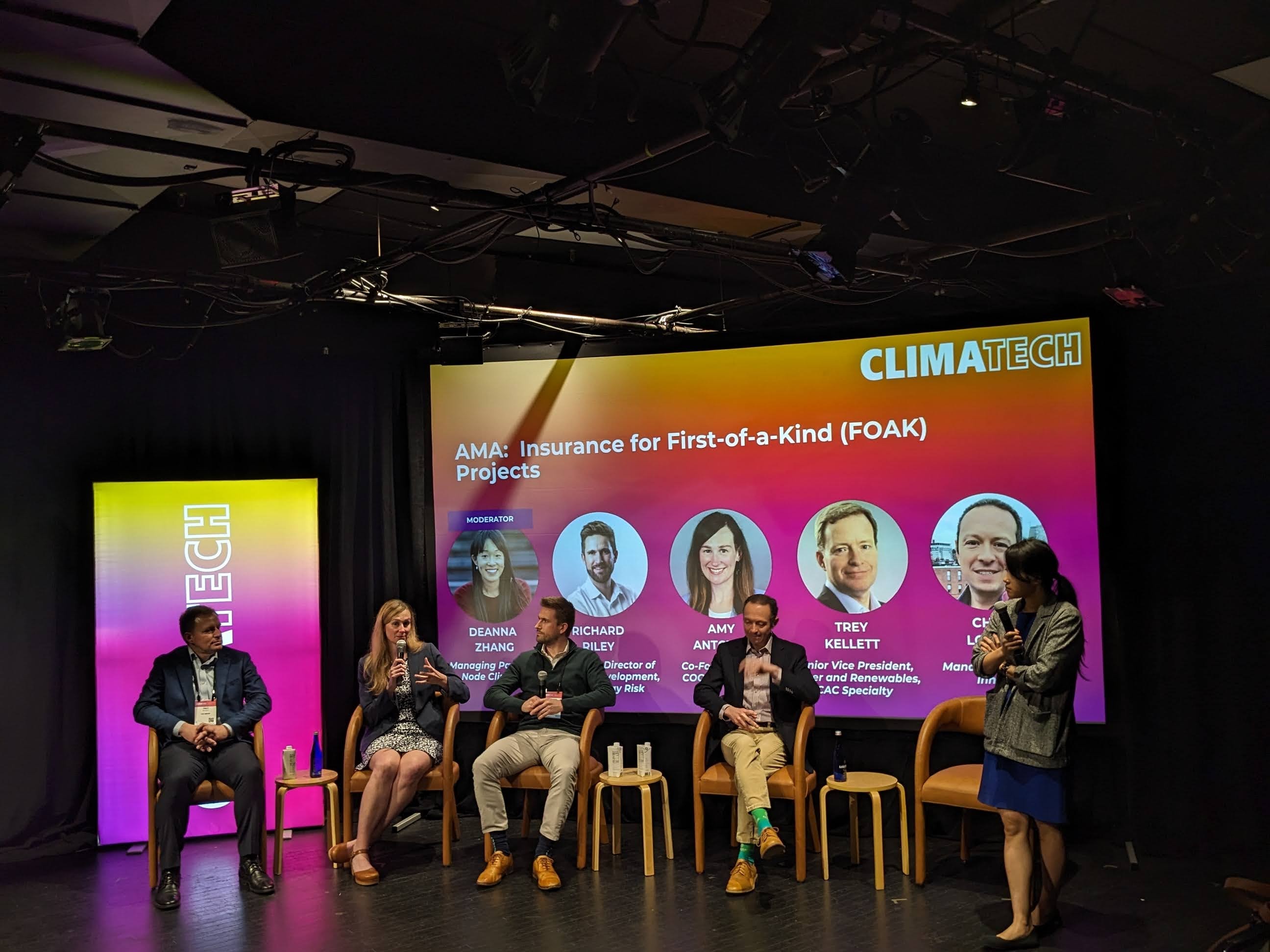
Last month, I had the chance to speak at Node Climate's “Ask Me Anything” session at Boston Climate Week alongside Richard Riley of New Energy Risk, Trey Kellett of CAC Specialty, and Chris Lowell of InnSure. During the Q&A, we answered questions from founders about first-of-a-kind (FOAK) insurance projects, insurability, technology performance insurance, and coverage options.
It was a great opportunity to get a sense of how people are thinking about insurance innovation and risk, and to hear what they want to know from GreenieRE.
But this experience got us thinking about the questions we get the most — from investors, reporters, and others curious about the work we do and why we do it. So, we pulled together our most frequently asked questions to shed some light on who we are and where we’re going as our model continues to evolve and grow.
Q: How does GreenieRE differ from traditional insurers?
A: Traditional insurers are built around proven loss histories. If a technology or business model doesn't have decades of claims data behind it, very often the response is to decline coverage, restrict terms, or price it out of reach. That approach works well for mature asset classes, but it creates a real financing bottleneck for the energy transition.
GreenieRE was purpose-built to fill that gap. We’re mission-driven at our core, and we see insurance as the missing piece needed to help remove bottleneck risks holding back climate infrastructure. We can spend time on challenging deals and work alongside carriers, MGAs, and brokers — not in competition with them — to help them extend capacity and develop new products for markets they'd otherwise have to walk away from. We also use both sides of our balance sheet to ensure our investments and our mission are aligned from day one.
Q: What kinds of projects does GreenieRE support? How has your appetite expanded?
A: GreenieRE started underwriting business in 2025 with a focus on clean energy infrastructure — solar, wind, storage, microgrids, distributed energy resources, and the technologies that connect and protect them. We work across residential, commercial, and community-scale projects, with a particular emphasis on markets that have historically been underserved by mainstream insurance.
We have active programs that focus on renewable energy infrastructure including property, trade credit, transactional liability (tax) and surety. Now we are expanding our appetite. In addition to businesses across a range of impact-focused and sustainability-conscious insureds, we are also open to a broader range of commercial and professional accounts. We are especially interested in commercial and personal lines with resilience or green enhancements. If it's good risk, we want to talk.
Q: What would you say to founders that are building pilot or FOAK projects? When should they start thinking about insurance?
A: For first-of-a-kind projects specifically, the earlier you engage, the better. We want to understand the technology, the operating assumptions, and what could go wrong. That conversation shapes not just the coverage, but the underwriting data we're building, which ultimately helps the entire ecosystem. Every FOAK project we work through becomes the dataset that makes the next project easier to finance and insure.
Don't wait until you're six weeks from financial close. Get into the market early, understand what coverage exists, where the gaps are, and who in the insurance world is willing to lean in with you. For new technologies, it may take longer to fill in all of the gaps. GreenieRE genuinely wants to hear from founders at the earliest stages and help problem solve.
Q: How do you deal with programs that lack historical data, given the evolving nature of the climate space?
A: This is one of the central challenges we were created to solve. We understand that many of the programs we work with, especially start-ups and those in the clean energy and sustainability spaces, may not have years of historical data that traditional insurance carriers like to see – and we’re okay with this. The availability of historical data doesn’t automatically translate into product viability or success, and experience isn’t the only factor we consider.
Our approach combines several things. We leverage the data and analytical infrastructure that already exists in the market, including the industry expertise provided by many of our MGA partners. We also work closely with engineering and technology experts to build forward-looking risk models where actuarial tables don't yet exist.
We're also structured to absorb more uncertainty than a traditional reinsurer would. Our mission-driven capital base mean we can accept more of the risks that others pass on, price them thoughtfully, and create the track record that eventually attracts commercial capacity. The goal is to help the market understand these evolving risks.
Q: Are there any projects or risks GreenieRE won’t work with?
A: While we’re open to working with many kinds of projects – especially given our newly expanded unwriting appetite – there are a few types of programs that are out of scope for us. We don’t underwrite heavy pollution or fossil fuel-related projects.
Within the impact space, we're thoughtful about risks where the probability of loss is high and there's no credible path to building an understandable, manageable risk profile over time. We want to take on hard risks — that's the whole point — but we're not in the business of absorbing losses without a framework for learning and improving. If a technology is fundamentally unproven in ways that can't be modeled or mitigated, or if the project structure creates moral hazard that undermines the insurance relationship, those are deals that we would be more likely to decline.
Q: How does GreenieRE ensure its profitability and growth while also remaining innovative and impact-focused?
A: Sustainable underwriting is how we protect the mission; we are deliberate about building a book of business that is both mission-aligned and financially sustainable. Through our coalition, through partnerships with MGAs and insurtechs that are building new products, and through our own product development work like Vensurety™, we’re staying close to innovation. We're motivated to spend time on challenging deals, which keeps us learning and keeps the pipeline fresh. The goal is to continually move the frontier of what's insurable, graduating markets from "too risky" to "commercial," and then moving on to the next hard problem.